
By Robert Pattinson
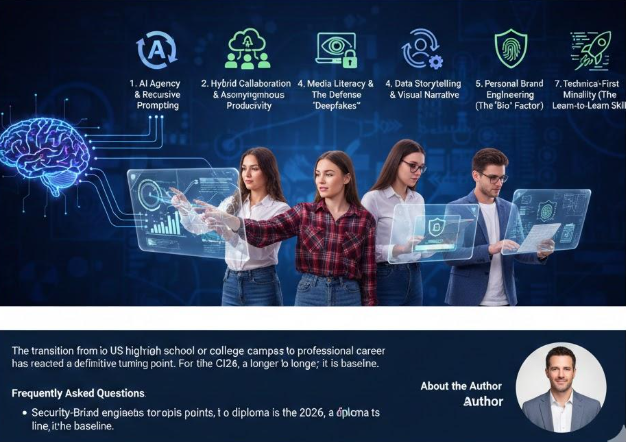
The transition from a US high school or college campus to a professional career has reached a definitive turning point. For the Class of 2026, a diploma is no longer the finish line; it is the baseline. As the US job market fully integrates agentic AI and hybrid working models, a “new foundational literacy” has emerged.
According to U.S. Bureau of Labor Statistics trends and recent National Skills Coalition data, 92% of all US jobs now require digital proficiency. However, the definition of “proficiency” has shifted. For students, mastering these seven pillars is the most effective way to stand out to recruiters in a competitive, tech-first market.
1. AI Agency & Recursive Prompting
In 2026, basic chatbot usage is a “given.” High-value candidates are those who understand AI Agency—tools that don’t just answer questions but execute multi-step workflows using platforms like OpenAI’s “Operators” or Anthropic’s “Computer Use.”
- Recursive Prompting: Moving beyond “Chain of Thought” to managing AI agents that can browse, draft, and refine simultaneously.
- Human-in-the-Loop (HITL): Demonstrating the ability to provide critical oversight to prevent “AI hallucinations” in corporate reporting and data analysis.
2. Hybrid Collaboration & Asynchronous Productivity
Success in the 2026 workforce requires mastering Asynchronous Communication—being productive across time zones without constant face-to-face meetings.
- The Tech Stack: Proficiency in “Unified Workspaces” like Slack, Microsoft Teams, and AI-integrated project trackers like Monday.com or Notion.
- Strategic Time Management: Transitioning to the workforce requires elite bandwidth management. Many students find that while mastering these technical tools, their traditional academic research workload becomes a bottleneck. Utilizing expert resources like Myassignmenthelp.com allows students to streamline their academic research and editing tasks. This strategic approach provides the necessary “bandwidth” to focus on high-level technical certifications and internships that drive 2026 hiring decisions.
3. Media Literacy & The Defense Against “Deepfakes”
With the rise of AI-driven identity fraud, US employers now view critical thinking as a core security skill.
- Lateral Reading: Verifying source credibility by navigating away from the original site to see what trusted authorities (like the Associated Press or Reuters) say.
- Detection Literacy: Proficiency with verification tools that flag AI-generated content. In 2026, passing an unverified “hallucinated” statistic to a stakeholder is considered a significant professional lapse in any US corporate environment.
4. Data Storytelling & Visual Narrative
Even “non-technical” fields now rely on data-driven decision-making. You don’t need to be a data scientist, but you must be Data Literate.
- Visual Narrative: Using tools like Tableau, Power BI, or Canva to turn raw datasets into a 30-second compelling insight for management.
- Interpretation: Understanding the “Why” behind analytics—bridging the gap between a spreadsheet and a business strategy. For students looking to build their portfolio, exploring diverse Statistics project ideas is an excellent way to practice these interpretation skills using real-world datasets.
5. Personal Brand Engineering (The “Bio” Factor)
Whether you are a high school senior or a graduating college student, your digital trail is audited by automated recruitment tools long before a human sees your resume.
- Platform Optimization: Treating your professional “Link in Bio” as a living portfolio of verifiable projects on GitHub, LinkedIn, or personal sites.
- Digital Hygiene: Curating personal accounts to reflect professional attention to detail. In the 2026 market, “discoverability” is a double-edged sword; your online presence must be an asset, not a liability.
See also: When Analytics Complexity Drives Supermetrics Alternatives
6. Security-First Mindset: Beyond Passwords
In 2026, every employee is a potential entry point for a cyberattack. Employers look for “Security-First” intuition in every department, from HR to Engineering.
- Identity Management: Moving beyond passwords to Passkeys and hardware-based Multi-Factor Authentication (MFA).
- Deepfake Phishing Awareness: Recognizing sophisticated voice or video clones in virtual meetings—a top threat for US corporations this year.
7. Technical Agility (The Learn-to-Learn Skill)
Perhaps the most vital skill in 2026 is Technical Agility—the ability to self-teach new software without a manual.
- The Search-First Mindset: Using technical forums, documentation, and AI assistants to solve glitches independently. This self-reliance is the engine behind the rise of the study-preneur , where students use technical agility to navigate the complexities of launching a business before they even receive their diploma.
- Cloud Fluency: Total comfort in live, collaborative ecosystems where version control (like Git) and real-time co-authoring are critical.
Frequently Asked Questions
Q.1 What are the most in-demand digital skills in the US for 2026? A: AI Fluency (specifically Prompt Engineering), Cybersecurity Awareness, and Data Interpretation are currently the top three priorities. Employers value “Agile” employees who can adapt to new tools every six months.
Q.2 Can I get an entry-level job without AI skills? A: While possible in manual sectors, most US corporate, creative, and administrative roles now view AI competency as a “baseline” skill, similar to how Microsoft Excel was viewed a decade ago.
Q.3 How can I improve my digital literacy while still in school? A: Focus on project-based learning. Build a personal website, take a Python course, or earn a Google Career Certificate. If you find your schedule overwhelmed by heavy research papers, consider using professional academic assistance to help manage your writing and editing workload. This allows you the time to pursue hands-on technical projects that carry more weight on a 2026 resume.
About the Author
Robert Pattinson is a senior content manager and academic strategist with over a decade of experience in the US EdTech sector. Robert specializes in bridging the gap between academic standards and modern workforce readiness, helping students navigate the complexities of the digital economy.